Thursday, December 27, 2012

Reporter's Question: How Do You Pay For It?

As Walter Pincus points out in today's Washington Post, "Iraq and Afghanistan are the first U.S. wars in which the American public was not asked to pay a cent in additional taxes."   We put it on the credit card, and as Pincus asks, "what were we thinking?"

A better question is why wasn't the press asking?   Why weren't reporters at every local newspaper and television station asking their members of Congress why they approved of putting a war on the national credit card?  All politics is local.  Scan the archives of your newspaper and local TV stations.  How many polled their members of Congress to find out why the members wanted to charge the war instead of paying for it?   We have a huge war debt because the local reporters failed to ask their members of Congress a simple, direct question.

Don't hold your breath waiting for reporters to ask questions or for members of Congress to answer.  When my reporting students sent certified letters to the Ohio Congressional delegation, letters that included the student's name, phone, and email making a response incredibly easy, most members did not respond to a simple request asking about an important topic:  healthcare.

But the failure is not with members of Congress.   And the failure is not with local reporters.  Let's change the topic to the present and run through the same scenario, i.e., ask a basic question to hold the member accountable.

How does every member of your state's delegation feel about banning the sale of assault weapons and large capacity gun magazines?   Can you find that story posted on your local newspaper or TV web site?  Why do local news organizations fail to ask questions that need to be asked and fail to hold their members of Congress accountable?   That's not a problem with the reporters, that's a management problem. Why are the heads of Belo and Scripps and Gannett and Tribune not demanding such simple direct reporting be done?

The media industry is undergoing an incredible upheaval, but those who will not only survive but also thrive will be those that decide to do news that matters instead of blather that doesn't.  

When journalism fails, bad things happen.   And when journalism fails, so will businesses that have forgotten that journalism is their product.

                                                              ###


Sunday, December 16, 2012

Direct Gun Questions

It doesn't get any easier than this.   Does your member of Congress support or oppose banning the sale of assault weapons?   They are unbelievably easy to buy.  Does your member of Congress support or oppose the sale of weapons at gun shows?    

Will your local TV station or newspaper ask the questions?

When journalism fails, bad things happen.  

                                                            ###

Friday, November 30, 2012

Where have you gone Rocky Marciano?


In 1955, possibly the most celebrated athlete was Rocky Marciano, the heavyweight champion.   I asked my students yesterday, "who is the current heavyweight champion?"   Not one student knew.   We no longer celebrate a sport where the goal is to render the opponent unconscious.      How long do you suppose we will celebrate the current most popular sport, one where its retired members have a tendency to commit suicide induced by the brain damage caused by the sport?

"Son, be sure to text while you drive" = "Son, be sure to play football."  Best of luck with that brain of yours.  

Retired NFL players are telling their own children not to play.  When do you think a college president may figure out a sport designed for violent collisions is not consistent with a university's mission of education?  When do you think sports reporters will start asking college presidents if a sport that causes brain damage is consistent with a university's mission?  Most likely, that won't happen until the lawsuits start coming and depositions are taken.

During Rocky Marciano's era, we had the tobacco industry.  What they sold to the public was a lie, one horribly detrimental to public health.  And as the lawsuits came, it was apparent the industry knew of the dangers and failed to disclose them.   Today, we have a similar threat to public health targeted to our sons.   And if you read the complaint filed by the NFL players against the league, you'll see amazingly striking similarities in the league's behavior and that of the tobacco companies.  

Later today, my computer-assisted reporting class hopefully launches a project it has produced on concussions.   Despite all the publicity about concussions, my students found school superintendents who don't even know if their school has a concussion policy.    My student reporters found several Ohio high schools that do not track concussions.   They also found a school district (Chillicothe) that is doing a first-rate job.  It has a detailed policy, one that requires immediate notification of the parent if there is ever a suspected concussion.  My students also discovered a school district where the football players must run around covered with pillows saying "careful, careful, careful" as they run their plays, because this is a school district that says it has not had an athletic concussion in 9 years.

What's happening at your school?   Does it track all concussions in games and practice?   Does it require concussion education for all coaches?   Does it require immediate notification of the parent for any suspected concussion injury?  That's an easy story for any reporter in any market to do.    But to do that story, you have to put down your pom poms and pick up your pen.

                                                         ###

Thursday, November 22, 2012

Because It's Football...

The students in my computer-assisted reporting class are about to launch a project on concussions.  We called high schools around the state to ask a couple basic questions:   does your school track all concussions in games and practice?  Does your school require mandatory concussion education for all coaches?

When I asked the superintendent of one of the powerhouse high school football programs in Ohio whether his school tracks all concussions in games and practice, he responded "no comment."

My student journalists found Ohio high schools that have no concussion policies. They found superintendents who don't even know if the school has a concussion policy.   They also found what must be a program where the student athletes wear helmets and run around with pillows and say "careful, careful, careful" as they run their plays.   My students found a high school that says it has not suffered an athletic concussion in 9 years.  As a colleague of mine who is familiar with the school system said, "they have more concussions than that in the hallway."

So here are some questions that journalists - not cheereleaders - should be asking.   Why don't they?  The answer is simple:  because it's football.

Why would university presidents support an activity that causes brain damage?

Why would parents support an activity that causes brain damage?   (Full disclosure:  I certainly would have allowed my son to play.   Now?   Never.   We are today with football where we were in the 1950's when you could page through a magazine and find an advertisement where a doctor told you the best cigarette to smoke.)

How could any high school not require mandatory concussion education training for all coaches?

How could any high school not require immediate parent notification of any suspected concussion?

Why aren't school superintendents asking legal counsel how the increased knowledge we now have about concussions has affected the litigation potential for the school district?

Why aren't university j-school directors pushing student journalists to ask the above questions? 

If your school district is in need of a knowledgeable attorney, check with the attorney who wrote the Athletic Concussion Protection Act of 2011 for the District of Columbia, Joseph Cammarata.  I just did a videoskype interview with him for our student reporting project.   When it comes to concussions, he is a wealth of information.  


And if your son is heading out to play what's become the number one sport in America ask yourself one question:  would you tell your son, "be sure to text while you drive."   Would you want him to take that risk?   What risk do you want your son to take with his brain? 

As the CDC points out, concussions are serious brain injuries.   In most concussions, the athlete never loses consciousness.   We will continue to play sports.   The problem usually doesn't come from the initial concussion; it comes from the player being put back into play, taking another hit to a brain that's already been rattled.   That's what happened to the high school athlete that prompted the law to protect high school athletes in the state of Washington.   Ohio has no such law.   Why?   Why do you think?   Because it's football.  

                                                           ###


Sunday, November 11, 2012

A Veterans Day Apology

On Veterans Day, NBC, CBS, ABC, the Washington Post and the New York Times owe our nation and its veterans an apology.   Had the press done its job, there would not have been a war in Iraq.  But rather than ask the questions that needed to be asked, the press played cheerleader.

When Journalism fails, bad things happens.   In this case brave men and women died who shouldn't have.  Thousands more have been scarred.  Thousands of American families have suffered loss and pain they never would have had to endure had the press done its job.

                                                            ###

PS:  FOX isn't included because Fox is brilliant.   It's the most magnificently designed profit generating propaganda organization in the history of communication.  I remember being in the Republic of Georgia during the run up to war watching my satellite channel and seeing a FOX News sponsored war rally.  It was great teaching material for students at the Caucasus School of Journalism & Media Management in Tbilisi as we discussed what is and isn't journalism.   The performance of the press we witnessed during the run up to war was not journalism.   On the propaganda front, FOX was and continues to be the clear winner. 

Saturday, November 10, 2012

Required Reading For Journalists

If this is required reading for journalists, in this day and age, not that many people will have to read it.   There aren't that many journalists.  There are lots of human microphone stands.   There are lots of sports pom pom wavers.   There are lots of business cheerleaders.   But unfortunately, journalists, those people who ask the questions that need to be asked, who dig, who don't take no for an answer, who go after the records and who seek verification rather than spending their time playing he said/she said, there aren't all that many of those.

So let me give this blog another title:  required reading for anyone in a journalism school or working in any organization that pretends to do news.

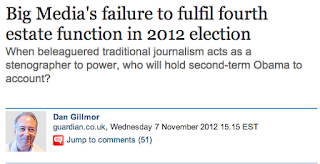
Read Dan Gillmor's column in the Guardian.   Then go ask your editor or news director one question:   should we start doing journalism or just keep doing the crap we're doing?


When journalism fails, bad things happen.
                                                         ###

Thursday, November 1, 2012

Sandy Demonstrates Failure of Press

The devastation caused by Sandy should have surprised nobody who believes in science.  As the headline in the New York Times said,  "For Years, Warnings That It Could Happen Here."

What serious questioning did Romney and Obama get about global warming?   Romney joked about it at his convention.  

Global warming is not a joke and there's certainly nothing funny or humorous about the failure of the press to ask serious questions about a serious issue.  Twenty-five years ago, most likely you would have seen hour-long documentaries on the networks addressing such an issue.   Now, the networks care about the exact same thing as BP, stock price and executive compensation.

How does such a serious issue go totally unquestioned by trained journalists at the presidential debates?   What's happening in your market?   Are your local reporters questioning each and every member of the Congressional delegation on the issue?   If not, write to the general manager of your local TV stations.   Write to the editor of your local newspaper.   Ask them why their reporters are failing to ask questions that need to be asked.   And for your newspapers, try to find the most in-depth videoskype interview its done with a climate scientist or politician on the issue.   If there is no such interview, ask your editor to explain why the newspaper doesn't bother to utilize today's technology to report. 

When journalism fails, bad things happen.
                                                                 ###


Saturday, October 27, 2012

An Exercise for Your Racist

Unfortunately, we can forget about the American television networks devoting any substantive time to one major problem facing the country:  racism.   But this election season does provide an opportunity to confront it.   Here's an exercise for you to do with your nearest racist.   There shouldn't be any trouble finding them.   They are in every community.

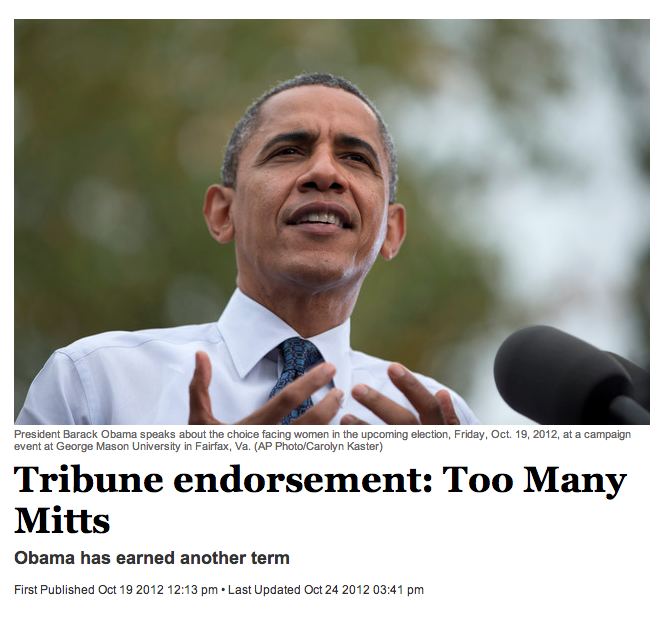
Print out the presidential endorsement from the Salt Lake Tribune.   Read it point by point to your racist.  Ask your racist to respond to each point.  That will be sure to cause cognitive dissonance.  And it's impossible to create behavioral change without first creating cognitive dissonance.

The Salt Lake Tribune uses logic, reason, and facts.   Racism, of course, doesn't allow logic or reason or facts.   Ask your racist to use logic, reason and facts when responding to each point made by the Salt Lake Tribune endorsement and watch closely.   You may actually observe cognitive dissonance.   You may actually have the opportunity to see the point where the racist shows that ever so slight movement away from racism and toward thought and reason.   More than likely, the racist simply won't listen.   The racist will simply ignore facts and logic.   Reasonable, thoughtful, rational people are not racists.  Rational reasonable fact-based thinking doesn't tolerate racism. Nobody should.
 
Nor should American news organizations consistently fail to address the issue.

When journalism fails, bad things happen.

                                                         ###

Sunday, October 21, 2012

Newsweek Suicide - Cincinnati Enquirer to Follow?

It's Sunday, only days to go before a presidential election.   There are major issues all over the country and all over the world.   What does the home page for one of Gannett's most profitable newspapers report?   Well, take a look.


The Enquirer wins again for most boring home page.
                                                            ###

Tuesday, October 9, 2012

Don't Bother Writing to Your Congressman

Students in my computer-assisted reporting class wrote to each member of the Ohio
video
Congressional Delegation making a simple request.   What happened?   Take a look.

Saturday, October 6, 2012

What a Reporter is Supposed to Do! It is BASIC

I'm not a fan of the professional wrestling version of journalism, that would be FOX & MSNBC.  But on Hardball, Chris Matthews did what every journalist is supposed to do:  ask for the evidence.

When former GE CEO Jack Welch tweeted that the "Chicago guys" did something to the "jobs numbers," Mathews asked Jack for evidence.   He had none.

What has happened to basic critical thinking?  A prominent CEO makes that kind of assertion with absolutely no evidence.   Applying Jack's standard, I could simply say I'm surprised to learn that Jack Welch is racist, that he made those comments because he doesn't like the fact that a black man is in the White House.   Welch can't fight the numbers with facts or evidence, so he just makes something up.   Obviously, I have no proof that Jack Welch is a racist, that he is opposing Barack Obama because he can't tolerate the fact that a black man is President of the United States.   But if I apply Jack Welch's own standards for intellectual rigor, I don't need any evidence.

Do you think Jack Welch would have tolerated that level of thinking from any of his executives at GE?  So why has he adopted such a miserably low standard for his own public statements?

Journalism requires verification.   It's a shame there's so little of it and way too much of he said/she said.   Being a human microphone stand is not journalism.   Chris Matthews didn't have to ask a hard question, just a simple direct one.   "Jack, do you have any evidence?"   No.

Then why would someone of Jack Welch's position make such a statement?   Oh that's right, he's a racist.   Again, I have no proof, no facts.   For this post, I'm just applying Jack's standards, standards no news organization should ever tolerate.
                                                               ###

Sunday, September 23, 2012

Reporters, not Candidates Ignore the Issue

There's an excellent article from the AP hightlighted on Huffingtonpost.com on how the presidential campaigns are ignoring the crucial issue of climate change.

But it's not the candidates who ignore this issue, it's reporters in market after market after market.
That's not the fault of reporters.   Reporters learn in a hurry not to suggest stories management doesn't want.   This story is too important to ignore.

Without question, there has been a candidate or two who has addressed climate change, and that gets reported because the press is really good at stenography.   But each and every member of Congress should be held accountable on this issue.  The fact that they aren't isn't a failure of reporting as much as it is a failure of management. 

It's difficult for any editor or news director examining page views and ratings to think that reporting on climate change is more important than covering Sunday's game.   It's the sports clips that drive page views.   But if we don't do such a great job covering the game, it really doesn't matter.   If we fail to cover climate change it does.  

Top corporate management at Scripps, Gannett, Belo and the rest need to make sure their news organizations focus on issues that matter, not blather that doesn't.   When journalism fails, bad things happen.   And failing on this issue will be really bad for generations to come.
                                                             ###

Thursday, September 13, 2012

Where's the WHY?

With attacks in Libya, Egypt and Yemen, why is there not more reporting on the WHY?   There appears to have been planning and coordination.   What we're seeing is not as simple as a response to a film trailer.   

In the United States at the time of the takeover of the U.S. Embassy in Iran, there was understandable outrage at the taking of American hostages.   There was little understanding or reporting on the why.   Every family in Iran was aware of American foreign policy; Iranians knew the CIA had orchestrated a coup to overthrow the leader of the country and install the Shah, a ruthless dictator who imprisoned or tortured or murdered political opponents.   Few American citizens shared that knowledge.   They did not realize it was the United States that was responsible for installing a ruthless dictator.

Following 911, understandably the citizens rallied around the flag.   Indeed, the United States had an opportunity for support of nearly the entire world community.   It was an opportunity to understand the why, and it was an opportunity wasted for world understanding.  For the most part, the press ignored the why and the why certainly was not what President Bush said.  911 did not happen because "they hate our freedoms."   Rather than examine the why, much of the American press just played human microphone stand. 

In a war of any kind, it's important to understand the enemy.   Understanding the enemy requires and demands an examination of the why. 

Zbigniew Brzezinski examines the why in Stategic Vision.   Unfortunately, there won't be much an examination of the why by the networks.   Why takes time, takes resources, takes thought, takes more than a freelance stringer, takes more than a Tweet or a Facebook post.  

When journalism fails, bad things happen.
                                                                     ###


Tuesday, September 4, 2012

Most Boring Newspaper Home Page?

You have to hand it to the Cincinnati Enquirer.   Its home page is unbelievably consistent, consistently boring.   With all that's happening, how does any editor make this a home page?

If anyone can find a major daily with a more boring page, please let me know.  That's a tough challenge.   I bet the Enquirer has got the "most boring award" won.
                                                   ###


Sunday, August 19, 2012

Romney's Taxes Are the Perfect Case Study

If Mitt Romney wanted to show the problem with the current tax system he would immediately show his taxes from the last several years.   More than likely, everything is perfectly legal.   Most likely, Mitt Romney has taken advantage of every single legal loophole that is designed to benefit the super rich.  It would be surprising if he had not.  

By showing his taxes he'd be able to showcase the American tax system as it now works. This is an ideal case study.   Romney's taxes demonstrate how class warfare was fought and won long ago by the super rich.   

So why isn't the Washington press corps making a point of that?     

"Mr. Romney, why would you not want to show your taxes?   Wouldn't your taxes demonstrate the need for tax reform, wouldn't your taxes demonstrate just how tilted our tax system has become with loophole after loophole designed to help the super rich, wouldn't showing your taxes help lead the debate for the need for tax reform fairness?"

You can't blame Romney for a Washington press corps that insists on doing such superficial analysis.
                                                                 ###

Monday, August 13, 2012

Real Sports Reporting

One primary contributing factor to college athletic scandal after college athletic scandal is the failure of the press to do its job.   Instead of report, the local press plays cheerleader.  

But the News Observer is a great exception and doing some first-rate reporting on athletic academic corruption at North Carolina.     Way to go News Observer; you're doing what reporters are supposed to do. 

As for the university, a News Observer headline says it best:  UNC Reluctant to Dig Deeper on Scandal.   The last thing we need is another university that has university ethics.   At least the public can be assured the News Observer will continue to dig and continue to report.  Finally, we have some sports reporting that is truly worth cheering.
                                                                 ###

Monday, August 6, 2012

Newspapers who get it v Newspapers who don't

It doesn't get easier than this.   Just click on the what the Denver Post is doing; then take a look at the Cincinnati Enquirer.   It's today v 20 years ago.   If you own Gannett stock, sell, sell, sell.

                                                              ###

Sunday, August 5, 2012

When Breaking News Happens - Minimize It!

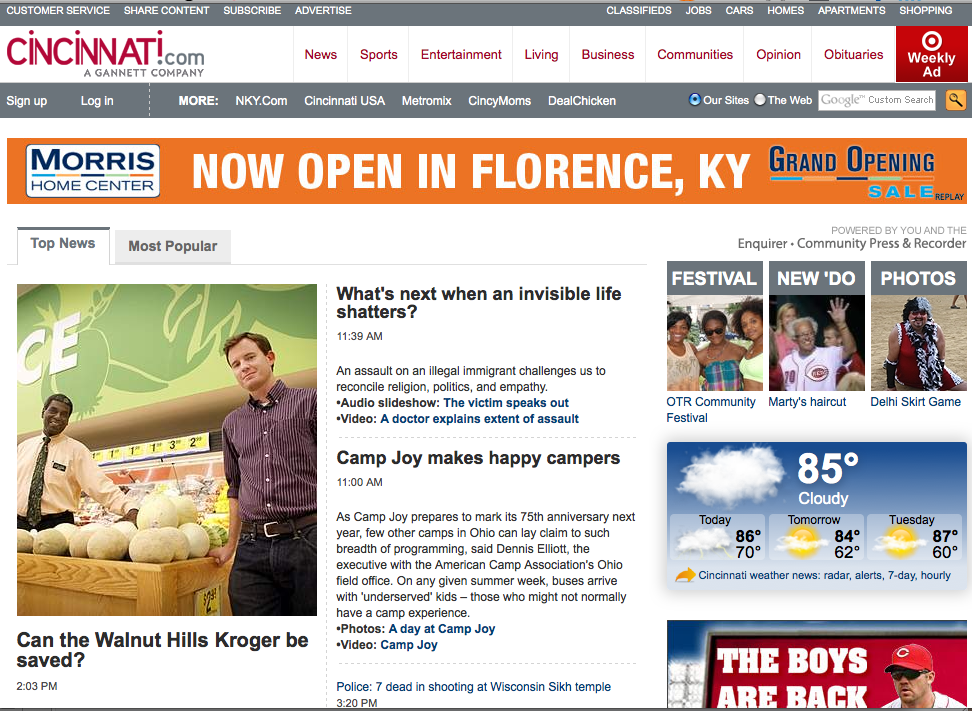
That seems to be the philosophy of the Cincinnati Enquirer.   Here's the home page this Sunday afternoon.  The headlines:  What's next when an invisible life shatters; Camp Joy makes happy campers; Can the Walnut Hills Kroger be saved.   And just above the fold in little bitty type: Police:  7 dead in shooting at Wisconsin Sikh temple.

The Enquirer certainly has an interesting strategy, and it will be interesting to see if being as dull as possible on the Sunday home page increases page views.
                                                                          ###


Saturday, August 4, 2012

To Succeed in Journalism STOP THE PRESSES

Newspapers have failed online for three simple reasons:  1.) they simply put their newspaper product online instead of developing an online product 2.) they failed to invest in training for multimedia journalists, and 3.) they failed to invest in online sales development. 

Newspapers died more than a decade ago.   Rather than recognize that fact, many newspapers kept doing their same product with one additional element, they copied and pasted their stories to a web site.  STOP THE PRESSES.

There are no newspaper journalists.   There are no TV journalists.   To succeed in the journalism business today, management has to hire multimedia journalists.    Conceptualizing the multimedia story is far different than writing a text story, and the conceptualization will change based on time and budget.

How effective is your multimedia newsroom?  Here's a beginning checklist for newsroom managers:

1.  Listen to the most compelling questions asked by your reporter in the most compelling interview currently on the site.    How would you rate the reporter's performance?   Many superb print reporters have difficulty talking on camera.   Have your reporters been properly trained?

2.  How many VideoSkype set ups do you have in your newsroom and how are they lit?

3.  How many effective VideoSkype interviews have your reporters done in the last month?

4.  What kind of traffic did those VideoSkype interviews get on Facebook, how many rt's on Twitter?

5.  How satisfied are your reporters with the training they've received on how to shoot one-man-band interviews?  How much did their productions improve following the training?

6.  Do all your tripods have clawball heads?

7.  How many stories has your organization broken in the last month from information obtained under public records requests?  Many veteran journalists make basic mistakes when writing a public records request.   Have your reporters been properly trained?

8.  What "holy shit, look at this" documents have your reporters uncovered in the last couple months?   How were those documents showcased on your site, how did your Facebook users react to them and what play did they get on HuffingtonPost and Newser?

9.   Inspect the reporting protocol of your reporters.   A multimedia story is planned on the front end, not after the fact.  What are your reporters doing?  Are they still thinking like print journalists?  I received an email from one of my graduate students interning at a major metro newspaper and what he describes is not a newsroom positioned for success.  He writes,  " Very few people think internet first (most only know about print and feel like it's too late to change their habits), and there is somewhat of a sense of impending doom. The people I talked to didn't even know the paper had an iPad app."

The managerial checklist for the multimedia newsroom is far different than the managerial checklist for a print newsroom.    To succeed in the journalism business, you have to stop the presses.  Think multimedia.   Most importantly for a news organization that wants to survive, you have to produce content that matters, not blather that doesn't.

And for anyone who doesn't want to stop the presses, read this piece, "Norwegian newspapers to die within 10 years."  

Newspapers died more than a decade ago.  Trying to keep them alive online by copying and pasting the print product will not resuscitate the corpse. 
                                                                      ###


Thursday, August 2, 2012

Cincinnati Enquirer Commits Suicide (or it should)

If the Cincinnati Enquirer web site were a person, relatives would be doing an intervention.
It appears the site is trying to commit suicide.  The home page is consistently visually dull, it is boring.

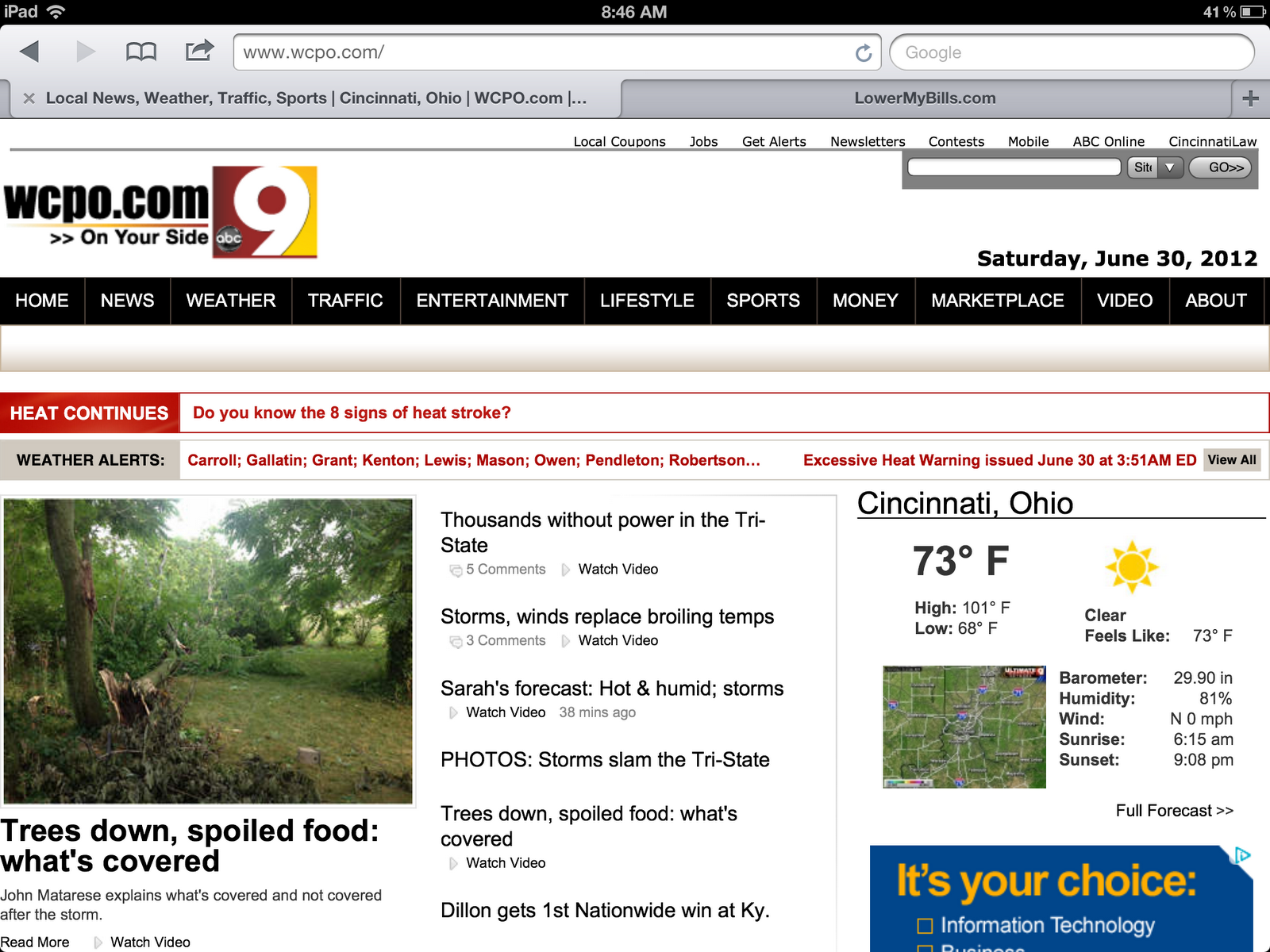
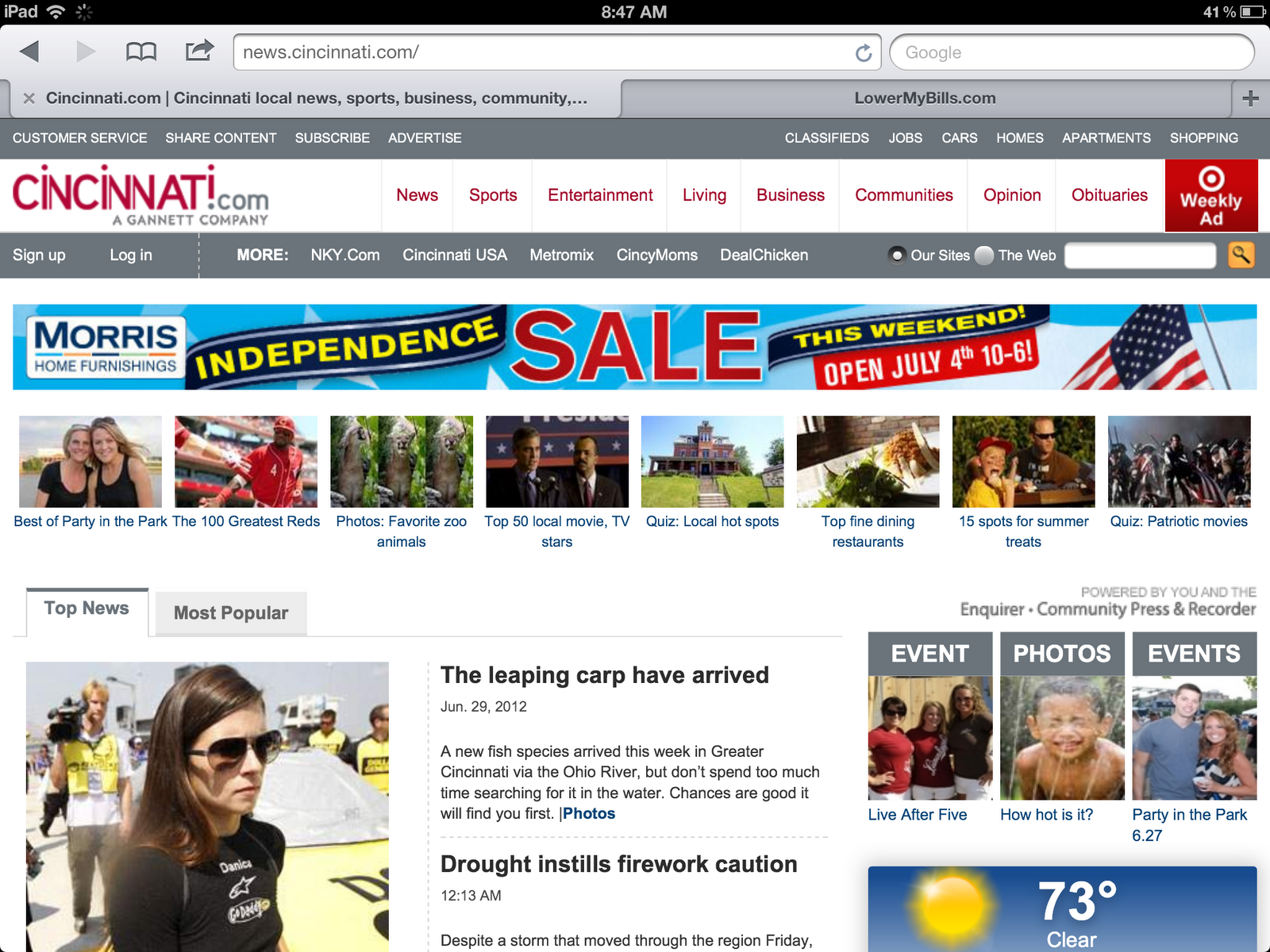
A few weeks ago when a major storm took out power of millions of homes across the country, WCPO and WKRC and WLWT had home pages featuring the storm.   That makes sense.  That's obvious.  That's the big story.  That's visual.   What did the Enquirer highlight?  I AM NOT MAKING THIS UP.   Leaping carp.  Take a look.


Today, it appears once again the Enquirer is trying to win the most boring news site web page in the world.  Congratulations Enquirer, you're winning.

Please, make it stop.  Sometimes suicide does make sense.   The Enquirer web site makes a first-rate argument for self immolation.
                                                       ###

Thursday, July 26, 2012

Opportunity Through Tragedy

Just as the Colorado shooting prompted discussion about gun control, the incident also provides an opportunity to examine one of the major problems facing the nation:  healthcare.

In Denver, NBC is reporting that victims at three hospitals will not have to worry about their medical bills.   Many of the victims are young; they lack health insurance.

What would it have cost?   And how does that cost to compare to what the victim would have had to pay in England or Germany or France or Norway or Belgium or any other industrialized country? 
Why is the United States the only industrialized nation where families go bankrupt from medical bills?

The television networks should be asking the questions and examining the issue.  But of course considering what a serious and expensive problem healthcare poses, the networks should have been doing in-depth stories on comparative healthcare systems around the world for years.  They haven't.  Maybe this tragedy might help them examine the tragedy of healthcare greed.   They ignored banking greed until the system collapsed.   Let's hope the networks don't make the same mistake on healthcare,  a topic essential to every American family outside the 1% who cannot afford to get sick in America.
                                                           ###
                                           

Friday, July 20, 2012

Asking the Wrong Question

It's impossible to get a worthwhile answer when you ask the wrong question.   The question is not "is Mitt Romney going to release his back tax statements?"   The question is "does a  Presidential candidate have a responsibility to be transparent with American voters on the candidate's financial history?"   If yes, how come.   If no, why not?

Why aren't reporters asking the obvious question?

Better questions lead to better reporting.  

Mitt Romney did a superb job running Bain Capital.   The goal of Bain Capital was to make money for its investors, not to create jobs.   So why would Mitt Romney during his presidential campaign position his incredibly successful company as something it never was, a jobs creator?   Why is he doing that?   And why does he run away from speaking honestly and openly about a phenomenally successful business?

Why aren't reporters asking him that?   Those questions would help reveal his thinking and his character; but those questions are not being asked.

Better questions lead to better reporting regardless of the topic.

Why don't local TV news operations cover the state legislature?  Is your local newspaper asking the local TV general manager?
 
Why do universities support a sport (football) that causes brain damage?  Are your local news reporters asking the college president? 

Why do Ohio MAC universities give more full scholarships to athletes than academic students? 

Why is the United States the only industrialized country where families go bankrupt from medical bills?   Have your local reporters asked every member of your Congressional delegation?

What threat does Afghanistan, a country where most homes outside Kabul don't have running water or electricity, pose to the United States that warrants the spending of billions of U.S. tax dollars?

What are the consequences of teaching a sanitized version of American history?

News organizations do a superb job covering something live; we can cover the start of a war live.   Where news organizations fail is asking questions that need to be asked.  Had we done that, we wouldn't have had to cover the start of the war live.  

When journalism fails, bad things happen.
                                                 ###


                                                                  ###


Wednesday, July 11, 2012

Job Ad Points to More Problems for NOLA

The NOLA Media Group is advertising for a reporter.   It describes the job saying, "In this role, you'll leverage your digital journalism skills in a dynamic work environment on an assigned news beat."

Today's multimedia journalist needs a far greater variety of skills.   At Kent State we train our students to think video, to think social media, to think Web first.   Despite all the changes in New Orleans, what NOLA says is needed for the job seems like a job ad written 20 years ago.   Take a look.
 
To be a good fit for this role you will have:

  • A degree in Journalism, Communications or a related field, or equivalent experience
  • 3+ years of journalism experience with a proven ability in reporting and writing.
  • Proven experience building, maintaining and engaging an active audience.
  • The ability to work independently under deadline pressure and prioritize tasks appropriately.
  • Demonstrated reporting, writing and organizational skills.
  • A solid understanding of news writing, journalistic ethics and story structure.
  • Experience with search engine optimization practices.
  • Demonstrated capability in capitalizing on high-value topics by engaging audiences frequently and with urgency.
  • Click the "Apply" button for further details... 
Apparently shooting and editing video isn't needed.   Apparently, there's not much concern about the person's ability to find sources via Twitter and Facebook or to leverage NOLA stories on social media.   Perhaps that's what NOLA means when it says it wants this 3-year veteran to have proven experience engaging an active audience.     The ability to do effective videoSkype interviews doesn't seem to matter.    Given the shake up there's been in New Orleans, it might be difficult to attract the multimedia journalists required to produce a first-rate product when the ad looks like one that could have run 20 years ago.

Or perhaps the NOLA Media Group's idea of online journalism is just putting up a bunch of text stories with a few still pix, in other words, continuing to do what it does now.     Good luck with that.
The ad says it empowers people to think outside the box.   There's no evidence of that either in this ad or on the web site.    So to help recruit multimedia journalists, start using multimedia reporting tools.

To build some traffic do an interview that can have some impact.   We watched Meet the Press fail to make Govenor Jindal answer a simple question, should Romney explain his offshore bank accounts?   When Jindal refused to answer, Meet the Press just let it go.   So this is simple.   A NOLA reporter needs to call the Governor for a videoSkype interview.  Ask the question again.  But this time, do what a journalist is supposed to do.  Get an answer.   If the Governor won't answer, ask the Governor why he won't answer a simple question about whether a presidential candidate should provide full transparency in his offshore investments.   Then put the videoskype interview above the fold on the home page.    And back at the NOLA  office for the reporter's camera, remember to light the reporter.   It will look a lot better.
                                                          
                                                                   ###

Wednesday, July 4, 2012

A Thank You Note For Your Newspaper

On today's 4th of July in a country where our national elected officials spend a huge percentage  of their time not on important issues facing our citizens but on raising money for their reelection campaigns, where the Supreme Court has ruled that control of the political system by the rich is just fine and dandy, where we can say with certainty we live in the only industrialized nation where families go bankrupt because of medical bills, it's time to write the CEO (most likely a member of the 1%) of the parent company of your metro newspaper and TV station a thank you note for letting the country's problems go so thoroughly unanalyzed.

Go to your newspaper's web site.  Try to find the most in-depth interview with your local Congressmen where the elected officials are actually pushed to provide specific answers to specific questions.   I live in Ohio, home of Speaker of the House John Boehner.   I can't find Boehner being pushed for specifics in an interview at the Plain Dealer or the Enquirer or the Dispatch or the Blade or the Daily News.

Go to your major metro newspaper's web site and try to find any examination of healthcare systems around the world.

If you're more of a history buff, go to the newspaper archives and check for the hard-hitting interviews the reporters did as Congress dismantled one fiscal control after another that had been put in place following the Great Depression (Yes, back then politicians had the political will and common sense to correct a dangerously out-of-control financial system).

In this day where we see one scandal after another in college athletics, where protecting a football program is more important than protecting children, go to the cheerleading (sports) section and see the hard-hitting interviews the sports reporters have done with college presidents about the runaway costs of college athletics.    Pay particular attention to how university presidents explain why it's good public policy for the highest paid public employee in state after state to be either a football or basketball coach.
See if there's any reporting about how athletic departments did their part in saving the auto industry since nearly every head coach gets a free car.   In Ohio and Wisconsin where governors have so vociferously complained about the costs of public employee salary and benefits, see what they say in the news articles examining the cost of college sports programs, most of which are multimillion dollar budget holes universities plug by charging fees to academic students.

In your letter, thank your CEO for his corporation's lack of serious reporting that's so desperately needed for an informed electorate in a democracy.   On this 4th of July when it's impossible to turn on the TV without seeing a political ad paid for by a billionaire, just say "thanks for the mess."

When journalism fails, bad things happen.

P.S.   And we can all be thankful to be in a country that has a public records law and free speech.   We can be thankful for news organizations like ProPublica and Frontline and Morning Edition and reporters and editors who actually do what journalists are supposed to do.
                                                          ###

Sunday, July 1, 2012

Where?

On today's CNN's Reliable Sources, Margaret Carlson made the point that there's been lots of coverage on the healthcare law (Obamacare).  Where?
 Sure, there's been lots of name calling.   Sure, there has been one generalization after another.  But where oh where has there been thoughtful reporting about the challenges facing American healthcare?   How can ours be the only industrialized nation where citizens go bankrupt from medical bills?   Why is that and how has it been examined on CBS, NBC, ABC and Fox? 

Why was single payer so quickly abandoned?  What can we learn from other countries? 

Frontline has done some excellent work.   But where on network television has this issue been thoughtfully reported?   If you have any URL's of first-rate examples, please send them.   Thank you.
                                                                 ###

Friday, June 15, 2012

University Presidents Ignore Lawsuit Risk

Why do you suppose Division I university presidents are so incredibly silent on the risk of litigation posed by college football, a sport that causes brain damage?   Just read through the complaint filed by the NFL players, and all the medical studies are certainly available and known to universities.

The NFL players get big money.   College players get what, the promise of a college education?  The NFL is a business, a billion-dollar business.   A university's mission isn't supposed to be to maximize team revenue.  Doesn't a university have an ethical, moral and educational responsibility to students?  What will a university president say when questioned by the lawyer for a football brain-damaged student? 

Under deposition, on the witness stand, what does a university president say when asked, "why does your university recruit students to participate in a sport known to cause brain damage?"

A better question is for all the local journalists.   Why aren't you asking that question of your university president?
                                                                    ####

Tuesday, June 12, 2012

A newsroom with possibilities

The Times Picayune says it's cutting 84 of the newsroom’s 173 employees.   That still leaves a sizable newsroom.

If these are multimedia journalists who utilize computer-assisted reporting, they can break a whole lot of news.

The key to a successful news operation is to do news.  The key to building an audience is simple:  do stories that matter; not blather that doesn't. 

Journalists can't waste time wringing their hands about what was.  The typewriter is dead.  The film camera is dead.  The print newsroom is dead.   Such things are now the province of historians.  Journalists look at the now and look at the future.   The future is overflowing with great stories waiting to be done.    There are too many human microphone stands; that makes for all the more possibilities for the journalist who actually does what a journalist is supposed to do. 

There are no newspaper reporters.   There are no television reporters.   There are no radio reporters.   There are multimedia reporters.   Those who recognize that will get excited at the incredible reporting possibilities today's technology allows.  I can do a video interview with anyone in the world who has high speed access.   I can produce video projects for a fraction of what they cost years ago.

So why do we still see newspaper web site after newspaper web site that looks a decade out of date?  Why are so many stories still print centric when newspapers died more than a decade ago?   Answer:  management is finally doing now what it needed to do more than a decade ago.
                                                               ###

Monday, June 11, 2012

The Scavenger Hunt: Find Substantive Healthcare Reporting

News organizations are supposed to examine substantive issues.   One of the crucial issues of our time is healthcare.   A couple years ago, Frontline did a superb analysis, a program titled Sick Around the World.

Here's an easy story.   Go on a scavenger hunt for in depth reporting on healthcare by network television.  Ask CBS, NBC, ABC & Fox to provide the three best examples of thoughtful analysis and reporting on healthcare.   Name calling and yelling about Obamacare do not count.

For any network that can't provide anything, ask a follow up question to each commissioner on the FCC:  does a television network making huge profits have a responsibility to operate in the public interest?

Another quick story:  what thoughtful analysis has your member of Congress done on healthcare options that make sense?    Is your member of Congress looking for solutions or just spouting political talking points?
                                                                   ###